Published by Distressed Works
Comparing millions vs billions vs trillions starts with one surprising fact: each step is 1,000 times larger. A million feels big, but a billion and a trillion represent much greater amounts.
Understanding that leap is useful when reading news about budgets, technology, populations, or enormous quantities. It's also what makes the phrase Millions. Billions. Trillions. so memorable.
Table of Contents
Millions, billions, and trillions at a glance
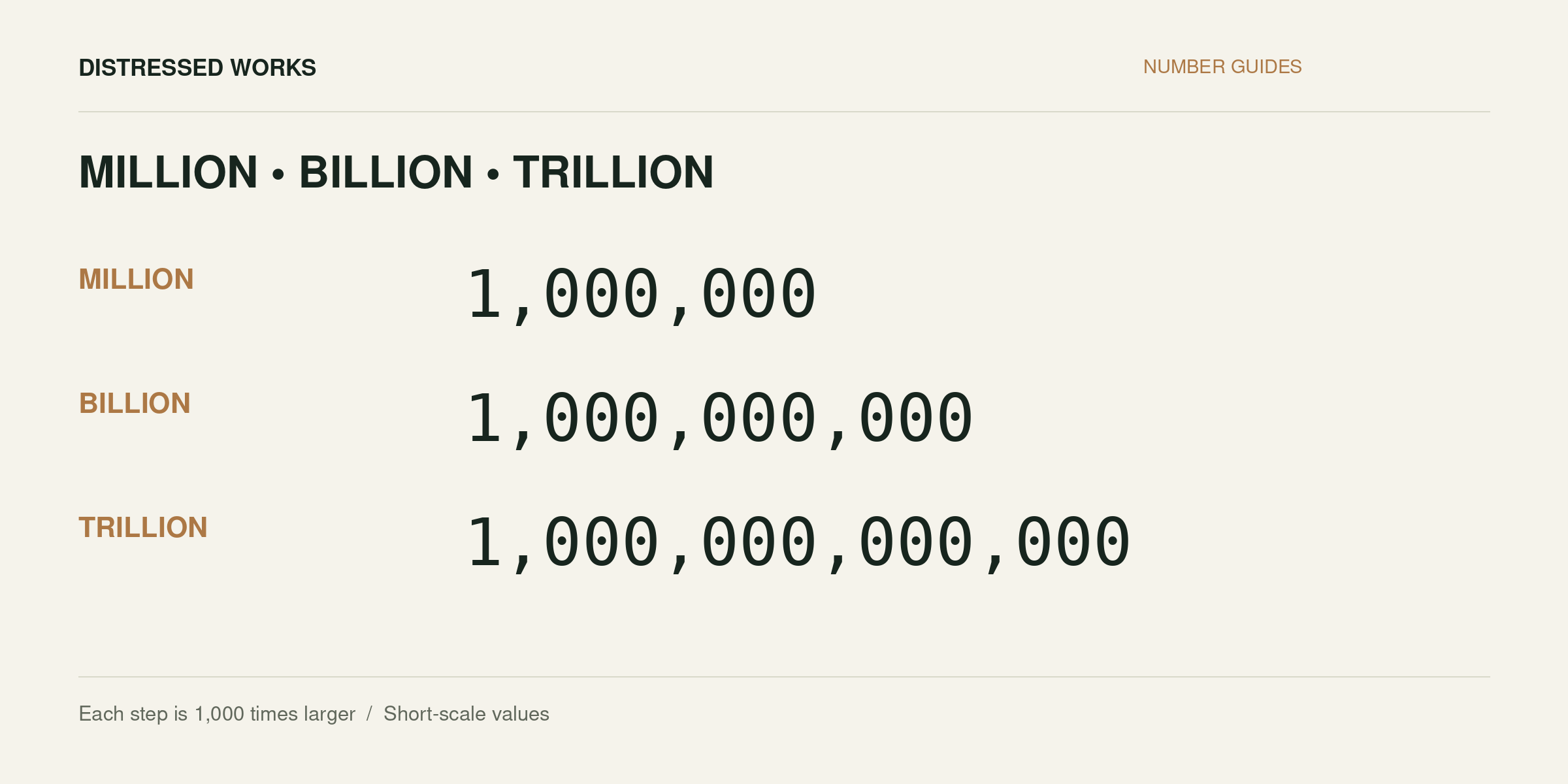
In the short scale used in the United States, the three numbers look like this:
That means 1 billion = 1,000 million, and 1 trillion = 1,000 billion. Put another way, a trillion is one million times a million. The words may look similar, but the magnitudes aren't close.
Million, Billion, Trillion, Lakh and Crore Converter
Want the dedicated tool? Open the crore, million, billion, trillion and lakh converter.
Number converter
Exact decimalsOne amount. Every scale.
Move between full numbers, millions, billions, trillions, lakhs and crores—with the same quantity in every unit.
- Full number
- Millions
- Billions
- Trillions
- Lakhs
- Crores
Millions vs Billions vs Trillions in Seconds
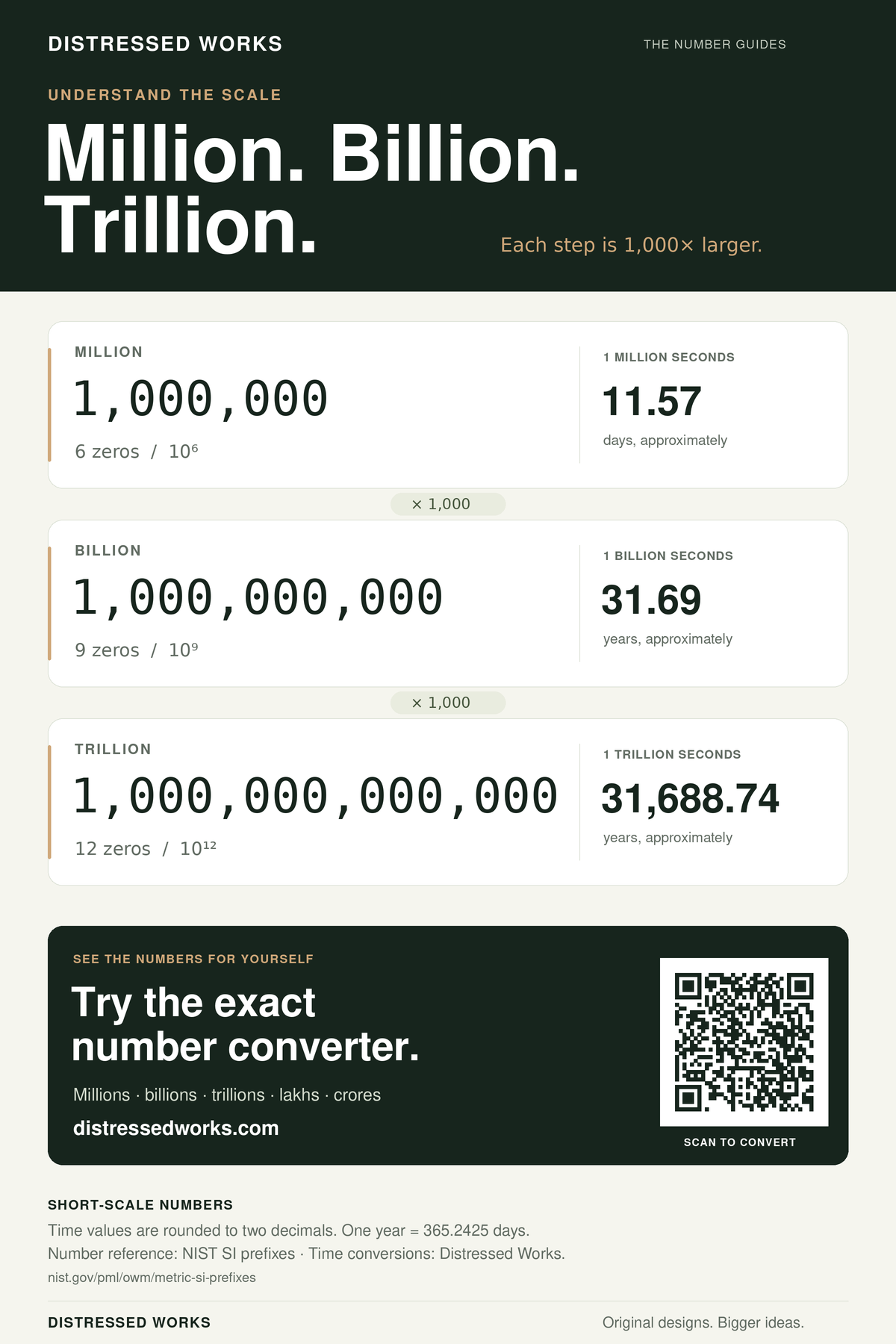
A million seconds is about 11.6 days. A billion seconds is about 31.7 years. A trillion seconds is about 31,689 years. Comparing the same unit of time makes the difference between these numbers easier to picture.
Less than two weeks.
Longer than three decades.
Many thousands of years.
How long is a million seconds?
1 million seconds equals 11 days, 13 hours, 46 minutes, and 40 seconds. In decimal form, that is approximately 11.57 days. Divide 1,000,000 by the 86,400 seconds in a day to check the conversion.
How long is a billion seconds?
1 billion seconds is approximately 31.69 years when a year is averaged at 365.2425 days. That is 1,000 times as long as a million seconds. If you counted one number every second without stopping, reaching a billion would take more than three decades.
How long is a trillion seconds?
1 trillion seconds is approximately 31,688.74 years using the same average year. Rounded to the nearest whole year, that is 31,689 years. It is 1,000 times as long as a billion seconds and one million times as long as a million seconds.
| Duration | Days, approximately | Years, approximately |
|---|---|---|
| 1 million seconds | 11.57 | 0.03169 |
| 1 billion seconds | 11,574.07 | 31.69 |
| 1 trillion seconds | 11,574,074.07 | 31,688.74 |
How to convert seconds to days or years
- Days: divide seconds by 86,400.
- Years: divide seconds by 31,556,952, using an average year of 365.2425 days.
These are duration calculations, rounded as shown. A calculator using a fixed 365-day year will give slightly different year totals, such as about 31.71 years for a billion seconds. Use the same year length when comparing all three numbers.
The key difference is the ratio: moving from million to billion, or from billion to trillion, multiplies the amount by 1,000. The similar-looking words describe very different lengths of time.
A simple trick for reading large numbers
Start at the right and separate the digits into groups of three. Read each group from left to right:
Each three-digit group gets a place-name: trillions | billions | millions | thousands | ones. A single 1 at the far left is one trillion.
Adding three zeros multiplies a whole number by 1,000. That's why each step from million to billion to trillion is so dramatic.
Why the phrase has meaning beyond mathematics
Numbers this large can represent scale, possibility, or the distance between an idea and what it might become. But the words don't have to mean money or a prediction of success. They can mean something different to everyone.
For a student, they may spark curiosity about the world. For an entrepreneur, they might be a reminder to think beyond today's limitations. For a creator, they can represent the kind of imagination that starts with a single small idea.
The important thing is not the number you reach. It's the perspective you bring to your next step.
How the original T-shirt brings the idea to life
The Millions. Billions. Trillions. design uses three stacked lines of bold, condensed lettering with an intentionally distressed texture. There are no charts or illustrations competing with the message. You read one word after another, and the scale keeps growing.
Both original variations place the artwork on the front of a black T-shirt—one with distressed white lettering, one with warm tan/copper lettering.
Frequently asked questions
One thousand. A billion is 1,000,000,000, and a million is 1,000,000.
One thousand. A trillion is 1,000,000,000,000.
There are 1,000,000 millions in a trillion. Divide 1,000,000,000,000 by 1,000,000 to get 1,000,000.
Yes. In the short scale, 1,000,000 × 1,000,000 = 1,000,000,000,000.
No. Its message is open to interpretation: scale, curiosity, ambition, or simply enjoying the power of three memorable words.
Like the three-word statement? Compare the white and copper Millions Billions Trillions shirts.
Compare Two Amounts Using the Same Unit
Before comparing a pair of figures, express both in millions, billions, or trillions. For example, 1.2 trillion equals 1,200 billion. That makes it 1,000 times 1.2 billion, even though both expressions begin with the digits 1.2.
Conversely, 900 billion is 0.9 trillion, so it is smaller than one trillion. Comparing only the digits 900 and 1 would give the wrong impression. The unit carries as much information as the numeral.
Convert millions, billions and trillions in either direction
| Millions | Billions | Trillions |
|---|---|---|
| 1 | 0.001 | 0.000001 |
| 1,000 | 1 | 0.001 |
| 1,000,000 | 1,000 | 1 |
- Millions to billions: divide by 1,000; reverse by multiplying by 1,000.
- Billions to trillions: divide by 1,000; reverse by multiplying by 1,000.
- Millions to trillions: divide by 1,000,000; reverse by multiplying by 1,000,000.
For example, 500 million is 0.5 billion, while 750 billion is 0.75 trillion. The smaller decimal does not mean the quantity shrank: only the unit changed. These conversions keep the original unit of measurement or currency; they do not convert dollars into another currency.
For a calculation check, divide the larger amount by the smaller one after converting both to full numbers. The result is a ratio, not a dollar amount or a duration. Use a clear unit label again when you report the original quantities.
The NIST SI-prefix reference lists the powers 106, 109, and 1012, which correspond to the short-scale values used in this guide.